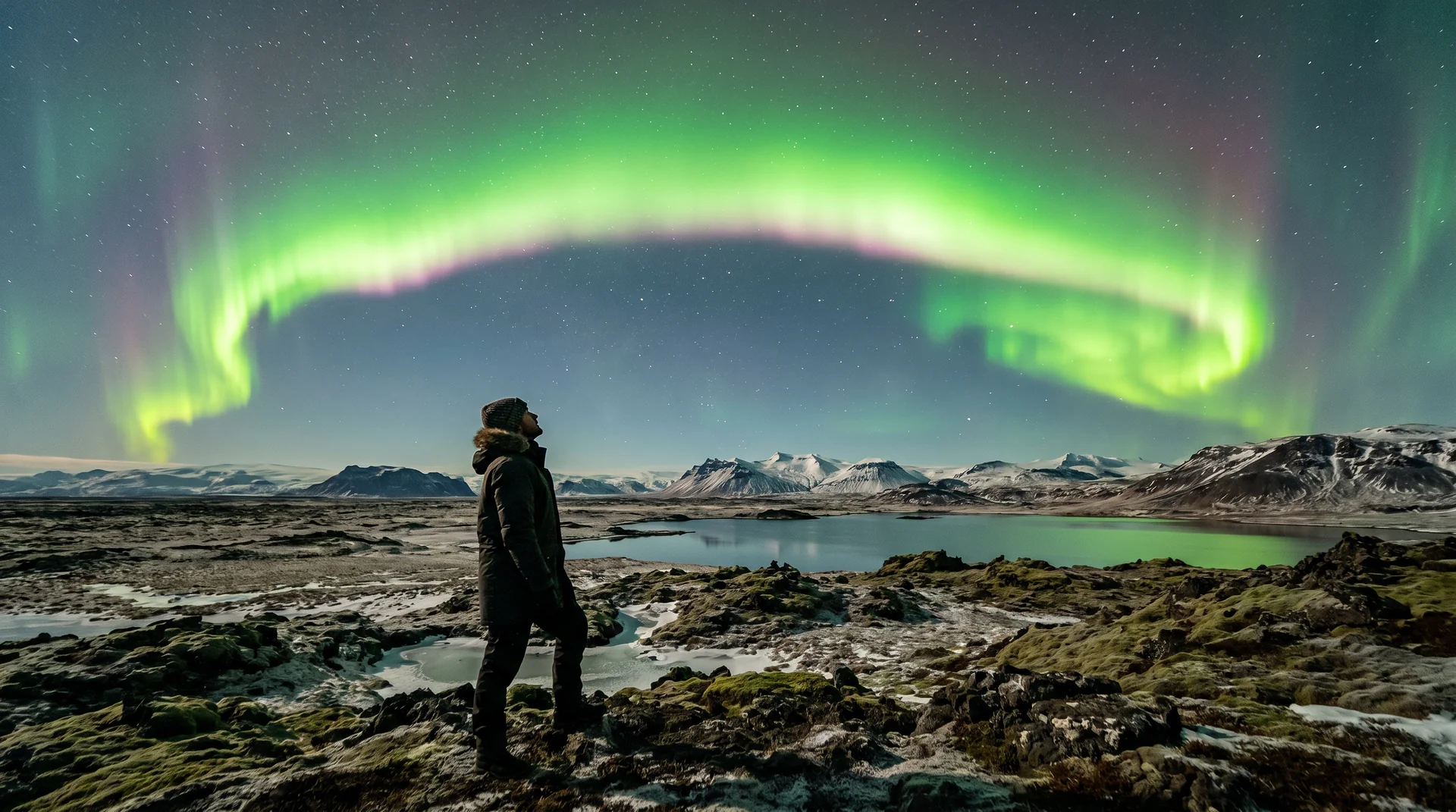
Waiting for the first aurora.
You wait for the aurora the way you wait for someone to call: knowing it will probably happen, not knowing when, doing other things badly in the meantime.
Every aurora night begins the same way. You check the Kp forecast, the cloud cover map, the road conditions. You make a sandwich. You put the tripod and the headlamp in the car. You drive somewhere fifty kilometres from the nearest streetlight, park, kill the engine, and step out into the cold.
What happens then, most nights, is nothing. A green smudge low on the northern horizon if you're lucky. You take a five-second exposure to verify it isn't your imagination. The camera shows: yes, the smudge is real, but it's also not getting any more impressive. You stand in the cold for another forty minutes. You drive home.
Three things have to agree
Aurora forecasting sounds technical and is mostly a matter of three separate conditions being true at the same time in the same place, none of which cares about the other two. There has to be activity. The sky above you has to be clear. And it has to be dark, which removes a large part of the year before you start.
Any one of them on its own is easy. Two out of three happens constantly and is worth nothing at all. The activity is up and the coast is under cloud. The sky is glass and the sun has done nothing interesting for a week. This is why the whole business is a numbers game played with nights, and why anybody promising you the lights on a named evening is selling something.
The practical consequence is that you plan for chances rather than for an event. A week gives you a handful of attempts, several of which will be cancelled by weather before you have got your boots on. Judge the trip on whether you gave yourself enough nights, because the number of nights is the only part of it you control.
The one lever you hold is location. Cloud is regional rather than national, and a clear patch a couple of hours away is a clear patch you can drive to, which is why these nights involve far more driving than anyone expects. You are not chasing the lights. You are chasing a hole in the cloud, which is a much more mundane thing to be doing at one in the morning and considerably more effective.
The cold is the actual skill
Nobody warns you that the difficult part is standing still. You dress for walking, because that is how everybody dresses, and then you stand in one spot in an open field in a wind for an hour and a half doing nothing whatsoever, and the clothing that was perfect for a hike becomes irrelevant. Standing still in wind is a different thermal problem and it needs more layers than you think, put on before you are cold rather than after.
Hands go first, because you keep taking gloves off for the camera. Feet go second, because you are standing on frozen ground and not moving. A flask of something hot is not a luxury item. It is the thing that buys you the last half hour, and the last half hour is disproportionately often the one where something happens.
The engine question resolves itself the first time you try it both ways. Sitting in a warm car with the engine running means your eyes never adapt and the glass fogs and you can see nothing at all, so you end up standing outside in the cold you were avoiding, except now you are also blind for the first ten minutes. Kill the engine, get out, let your eyes go. It takes longer than you expect. Twenty minutes in, the sky has stars in it that were not there when you arrived.
Red light on the head torch, and off entirely if anyone else is out there. One white beam wrecks the dark adaptation of everybody in the field, including yours.
Somewhere in the second week the ritual stops feeling like a chore. Checking the sky before bed becomes automatic, the way checking the sea state becomes automatic on the coast. You are not doing it because tonight looks promising. You are doing it because you have finally accepted that the sky does not consult the forecast, and the people who see the good ones are the people who looked.
What the camera sees and you do not
This is the part people are oddly unwilling to say out loud. A long exposure is not a record of what was in front of you. It is an accumulation. Fifteen seconds of faint green becomes a vivid photograph, the vivid photograph goes on the internet, and it is the photograph rather than the sky that most people have in their heads when they land.
So here is the unglamorous version. A weak aurora looks, to the naked eye, like a pale grey-green cloud that barely moves, and you will not be certain it isn't an actual cloud until you take a frame to check. Most nights are that. It is still worth standing there. But if you came expecting the photographs, most nights will read as failure, and the failure is in the expectation rather than in the sky.
The exception, when it arrives, needs no camera to be convincing, and you will know instantly which of the two you are looking at, because you will not have to ask anyone.
And then one night
Eight nights into the trip the sky stops messing around. You step out of the car at a pullout near Vík and the whole northern half of the sky is moving. Not the slow brightening you'd half-expected, but actual movement, vertical curtains shifting east to west, magenta edges on the bright parts, structure you can read in real time the way you can read smoke.
Colour arrives second. First it is white, or something the eye reads as white because it is far too bright to be the grey you have been calling aurora all week, and only after a few seconds does the green assert itself. The bottoms of the curtains go pink. Directly overhead the whole structure converges towards a point and appears to rain downward, which is a thing I had seen in photographs and quietly assumed was a lens effect.
I did not take a photograph for the first ten minutes. I would like to claim that was a decision.
The whole northern half of the sky is moving. Actual movement, structure you can read in real time.
Afterwards
It lasts forty minutes. Then it fades to that same green smudge you've seen all week, the one you'd been calling 'the aurora' as a politeness. You realise you'd been wrong about what aurora was.
You drive back to the guesthouse without saying anything to your travelling companion, who's been asleep in the passenger seat the whole time and missed it. That is a thing I have thought about a good deal since. I told myself at the time that waking someone out of real sleep, in the cold, for something that might have stopped before they got their boots on, was the considerate call. I no longer believe that. Wake them. Forty minutes is not long to be awake and it is a long time to have missed.
Two nights later there was another one, weaker but unmistakably the real thing, and I did not set the tripod up at all. I stood in a car park with cold hands and watched it until it stopped. I have no photographs from that night and it is the one I can still see.
The waiting, in the end, is not a tax on the experience. It is what makes the sky legible. Eight nights of grey smudges are what taught me the difference, and somebody who flew in for a single clear night and got lucky would have seen the same sky and understood less of it.