A week without darkness.
The first night you forget to sleep is a Tuesday. You realise it on Wednesday afternoon.
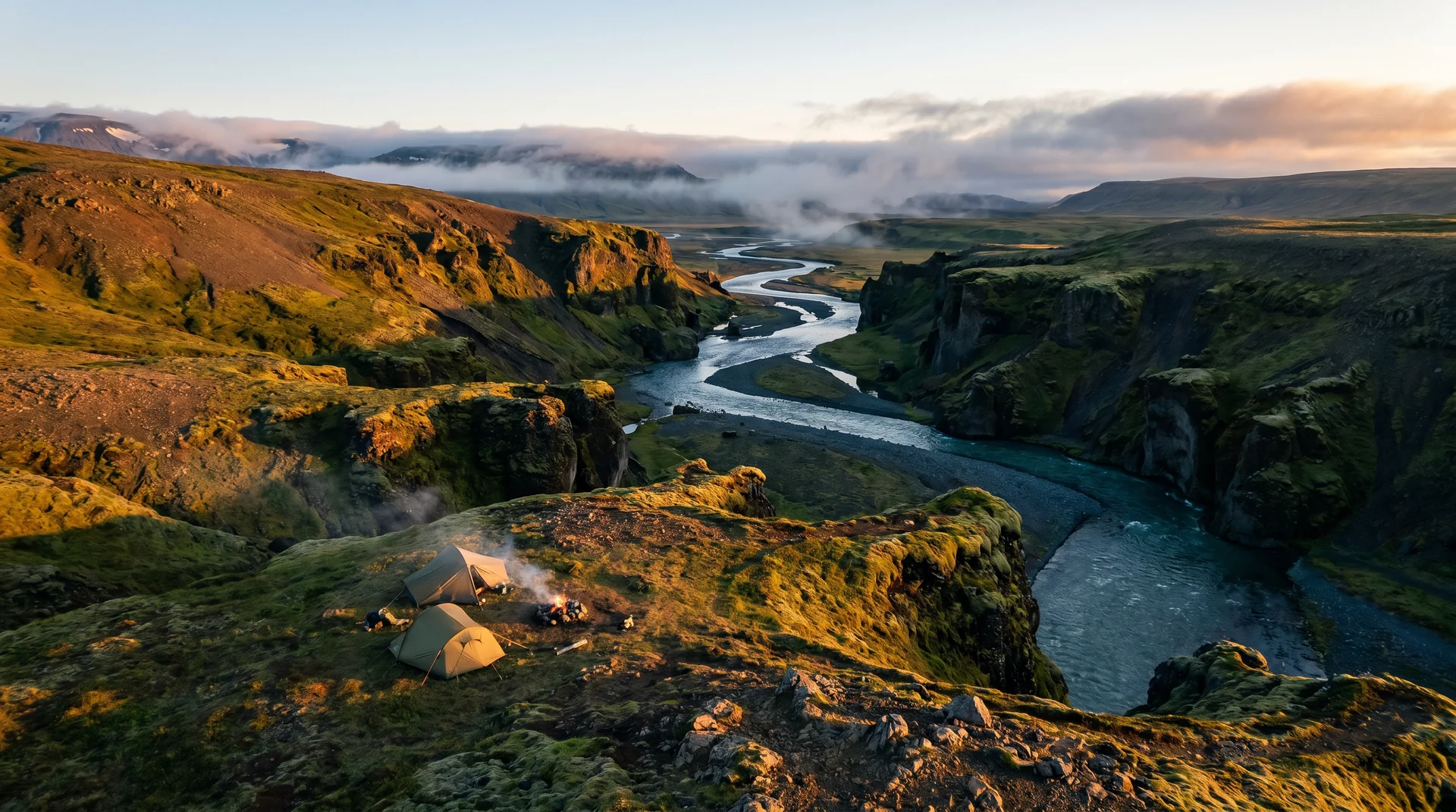
In June, the sun in Iceland never quite leaves. It grazes the horizon at some point near 23:30 in the south, dips behind a fjord for an hour or so, and is back at it before you've finished tea. There is no real night for six weeks. The light just changes character: golden, then pewter, then back to a soft warmth that photographers call magic hour, except it lasts five hours.
You think you'll get used to it. You don't, exactly. What happens is you stop pretending to keep a schedule. You drive when the light is interesting, which is almost always. You sleep when your body forces it, which is usually somewhere between 02:00 and 06:00. You eat when you're hungry, which is increasingly out of phase with restaurant hours.
What the body does about it
The tiredness does not arrive as tiredness. It arrives as a slight flatness of judgement. You take a corner faster than you meant to. You read a sign twice. You have the same conversation with your travelling companion for the second time and neither of you notices until the end of it. Nothing dramatic happens, which is the problem, because the thing that normally keeps you honest about fatigue is the feeling of being tired, and daylight is quietly suppressing that feeling.
So you stop trusting how you feel and start using rules instead. No driving after a certain point in the evening, even though the evening looks like four in the afternoon. A real meal at a boring, ordinary hour. Write down where you slept, because otherwise the days stop having edges and by Friday you cannot reconstruct which lake was Wednesday.
The sleep mask is not optional
Every Icelandic hotel and guesthouse has thick blackout curtains. They are not enough. Bring a real sleep mask, the kind with the contoured eye cups and the velcro strap, the one you laughed at in the catalogue. The light leaks under your eyelids like seawater under a door.
Curtains fail at the edges. There is always a bright seam down one side of the window and a bright bar along the top, and in a room where everything else is dark those two lines are enough to keep some part of you convinced it is the middle of the afternoon. Campervans are worse, because the windows are small and numerous and the curtain is a piece of fabric with press studs on it. Gaffer tape and a black bin liner is not elegant and it works.
Earplugs turn out to matter as much as the mask, for a reason nobody warns you about. The birds are not sleeping either. Coastal Iceland at two in the morning in June is loud in a way that has nothing at all to do with people.
There is no real night for six weeks. The light just changes character.
The shape of an actual day
Ours settled, by about the fourth day, into something that would look deranged written on a calendar and felt entirely reasonable from the inside. Wake somewhere near eleven in the morning. Coffee and the forecast, which is the real first task of any Icelandic day in any season. Drive in the early afternoon, which is the worst light and the busiest hour and therefore exactly the right time to be doing something as unremarkable as covering distance.
Then the long good part. From late afternoon until deep into what a calendar would call night, the light improves, the roads empty out, and the places that had a queue at two o'clock have nobody standing at them. Eat somewhere in there if you have thought about it in advance. Sleep when the body finally insists.
Written down, that is a nocturnal schedule. Lived, it is simply following the light, and the fact that the clock disagrees stops being interesting after about three days.
Midnight is a direction, not a time
The thing that is hard to convey is that the light does not go down, it goes sideways. Further south, evening is a vertical event: the sun drops, the shadows lengthen, and then the whole thing ends. Here the sun tracks along the horizon for hours, so the shadows swing round like the hand of a clock without ever getting properly long, and the landscape stays lit from a low angle out of a direction that keeps moving.
The practical version is that a valley which was flat and unreadable at noon becomes three-dimensional at one in the morning, and a mountain face that sat in shadow all afternoon gets its own hour some time after midnight. If there is a particular thing you want to see well, the question is no longer whether the light will be good. It is which hour of the night the light will be pointing at it.
This is also why you keep driving past your own bedtime. Not because you are chasing anything, but because the country keeps rearranging itself behind you and it starts to feel rude to stop watching.
Photography stops being about the golden hour
Everywhere else, landscape photography is mostly logistics: being in the right place during the short window when the light is any good. Here that constraint is removed, and it turns out the constraint had been doing a great deal of work. When the light is beautiful for five hours you have to decide what you are photographing, and a lot of people, myself very much included, discover they had been letting the light make that decision for them.
The compensation is that you can work slowly. You can walk to a place, look at it, decide it isn't working, walk somewhere else, come back, and the light will not have abandoned you in the meantime. I have never been so unhurried with a camera and I have never thrown away so many frames afterwards, and I suspect those are the same fact seen from two ends.
The one thing summer cannot give you is a dark sky. No aurora, no stars, none of the long-exposure night work the winter version of this country is famous for. People book June and then ask about the northern lights, and the answer is not that the aurora is unlikely, it is that you cannot see it against a lit sky. Worth knowing before you choose the month rather than after.
Everyone else is awake too
The strangest part is not the light itself. It is the social normality of it. Campsites are quietly busy at midnight. There are children playing football on grass at an hour that would be alarming anywhere else, and nobody is behaving as though anything unusual is happening, because to them nothing is.
The practical consequences are small and constant. Restaurants and fuel stations keep their own hours regardless of how bright it is outside, so you will be hungry at a time when the country is closed. Carry food you can eat cold. Fill the tank when you pass a pump rather than when you need one, which is reasonable advice in Iceland in any season and better advice when your sense of time has come off its hinges.
There is one more consequence worth stating plainly: in summer the interior is open, and that changes what a week can contain. The tracks that are not a question for most of the year become a question you are at least allowed to ask. Whether the answer is yes on any particular day remains the country's decision rather than yours, but in June the conversation exists.
Coming back
Re-entry is the part nobody mentions. The first true night you experience afterwards is disorienting in a way the endless day never was. Darkness in the evening feels like an error, like something has gone wrong with the world rather than with you, and it takes about a week to wear off.
By day five you stop checking the time. By day seven you realise you've been making decisions based on weather and light, not on the clock, for a long stretch. It is the closest most travellers get to being on the country's terms rather than their own.
That is the thing I tried to bring home, and it did not survive contact with a calendar. But for one week I lived at the speed of the weather, and I have been trying to get back to it ever since.